
Agentic Data Analytics Built on Enterprise Knowledge
d.AP enables Agentic Data Analytics grounded in an enterprise Knowledge Graph, allowing AI agents to analyze data, reason across relationships, and deliver explainable answers that organizations can trust.
- Enable AI agents to reason across enterprise data
- Deliver explainable analytics grounded in knowledge
- Ask complex questions in plain English using Aluna
- Accelerate decision-making across the organization
Agentic analytics use cases • Architecture walkthrough • No infrastructure replacement

Why Traditional Analytics Breaks Down in Complex Enterprises
Organizations invest heavily in analytics platforms, dashboards, and data pipelines.
Yet critical questions often require manual investigation across multiple datasets and systems.
Because while the data exists, the relationships between data sources are rarely modeled explicitly.
Traditional analytics queries data. Agentic analytics reasons across knowledge.

From Dashboard Analytics to Agentic Data Reasoning
Traditional analytics platforms focus on dashboards, reports, and queries.
Agentic Data Analytics focuses on reasoning across enterprise knowledge.
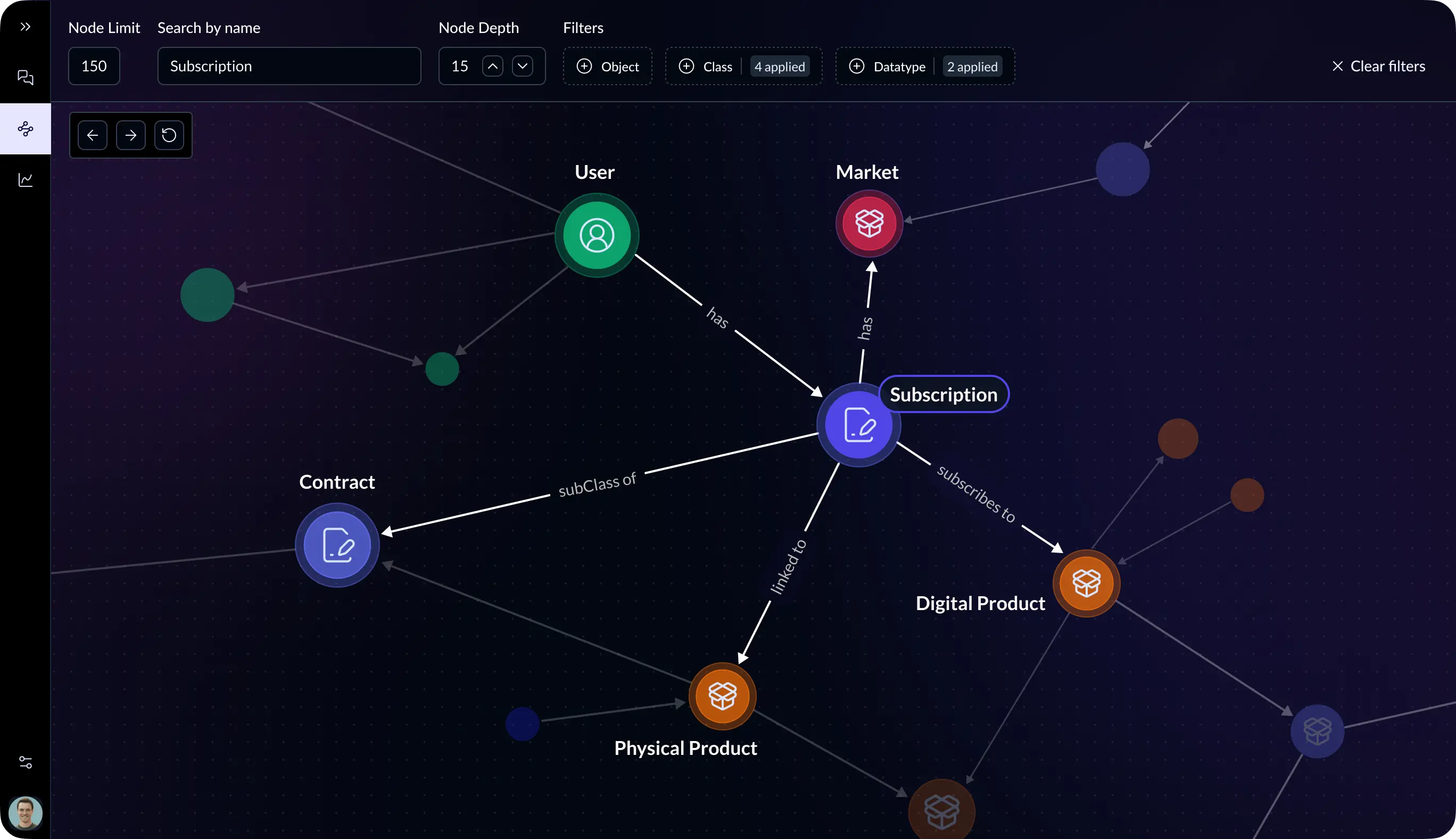
With d.AP, AI agents operate on a Knowledge Graph that models relationships between data, systems, and concepts.
AI is able to move beyond static reporting toward dynamic analysis and decision support.
Traditional Analytics
- Dashboard-driven insights
- Manual data exploration
- Limited cross-system reasoning
Agentic Analytics with d.AP
- AI-driven reasoning
- Knowledge-based analysis
- Cross-system decision intelligence

Step 1: Knowledge Graph Foundation
Enterprise data is connected into an ontology-grounded Knowledge Graph that models relationships between systems, entities, and processes.

Step 2: Semantic Understanding
The Knowledge Graph provides structured meaning and context across the organization’s data.

Step 3: Agentic Reasoning
AI agents operate on the Knowledge Graph to analyze relationships, detect patterns, and answer complex questions.
Step 4: Natural Language Access via Aluna
Users ask questions in plain English and receive answers grounded in enterprise knowledge.
Real results, real impact.
Faster Decision Intelligence
AI agents analyze relationships across enterprise data to surface insights quickly.
Explainable AI Insights
Because answers are derived from the Knowledge Graph, organizations can trace how conclusions are reached.
Reduced Manual Analysis
Teams spend less time investigating fragmented data and more time acting on insights.


Questions d.AP Can Help Answer ~ Reliably
How are these entities, systems, and processes connected?
What dependencies exist across these datasets?
Why did this outcome occur?
What factors influenced this decision?
Ask Questions. Get Explainable Answers.
d.AP exposes the Knowledge Graph through Aluna, enabling users to ask complex analytical questions in natural language.
Aluna returns answers grounded in enterprise knowledge.
Every answer is:
- Derived from the Knowledge Graph
- Grounded in enterprise ontologies
- Traceable to relationships and evidence
This allows organizations to adopt AI analytics without sacrificing trust or explainability.

Designed for Enterprise Data Architectures
d.AP integrates with existing enterprise data platforms and analytics systems.
Deployment options include:
- EU-hosted SaaS (VPC)
- Customer-managed cloud environments
- Hybrid deployments
Organizations typically begin with a focused domain such as analytics use cases, operational intelligence, or decision support.
Who d.AP is for
Leadership
Enterprise analytics teams
AI and data platform leaders
Business intelligence teams
Frequently Asked Questions
We answer your questions in advance. We've missed something? Let us know.
What is agentic data analytics and how does d.AP enable it?
.svg)
Agentic data analytics refers to AI agents that can analyze data, reason across relationships, and answer complex questions autonomously. d.AP enables this by grounding AI agents in an enterprise Knowledge Graph, allowing them to reason over structured relationships rather than isolated datasets.
How is this different from traditional BI or analytics platforms?
Traditional analytics platforms rely on dashboards, queries, and manual data exploration. Agentic analytics allows AI agents to reason across enterprise knowledge and answer questions directly, reducing the need for manual analysis.
How does d.AP prevent AI hallucinations when answering analytical questions?
d.AP grounds AI responses in its ontology-driven Knowledge Graph. When users ask questions through Aluna, answers are derived from structured relationships and enterprise data rather than probabilistic guesswork, making them explainable and traceable.
Does agentic analytics replace existing data platforms or BI tools?
No. d.AP integrates with existing data platforms and analytics tools. These systems remain the systems of record, while d.AP provides the knowledge layer that allows AI agents to reason across them.
What kinds of questions can d.AP answer that traditional systems struggle with?
Questions that require understanding relationships across multiple systems, such as identifying dependencies, explaining outcomes, or analyzing complex operational patterns.