
Makes Your Data Fabric Decision-Ready
A knowledge layer that sits above your data fabric, turning connected data into explainable, AI-ready decisions
- Adds meaning and context to data fabrics
- Accelerates decision-making across domains
- Enables AI without hallucination or guesswork
- Makes outcomes explainable and auditable
For enterprise data fabrics · No pipeline replacement · Architecture-led walkthroughs

Why Data Fabrics Alone Don’t Deliver Better Decisions
Data fabrics succeed at connecting and orchestrating data, but connection alone does not create understanding.
In practice:
- Data is accessible, but not contextual
- Relationships between entities remain implicit
- AI systems lack grounding and trust
- Decisions still require manual interpretation
A data fabric moves data. Decisions require meaning.

Not Just Data Connectivity. A Decision Knowledge Layer.
A data fabric focuses on how data moves. A knowledge layer focuses on what data means.
d.AP doesn't replace your data fabric. It sits above it, modeling entities, relationships, and constraints to create a shared semantic understanding across domains.
This is how data fabrics become decision platforms.
Data Fabric
- Connectivity and orchestration
- Access across systems
- Schema-level understanding
d.AP Knowledge Layer
- Meaning and relationships
- Decision-level context
- Explainable reasoning

Step 1: Fabric Integration
The data fabric continues to manage access, movement, and governance of data.

Step 2: Semantic Modeling
Business entities, relationships, and constraints are modeled explicitly, independent of physical data sources.

Step 3: Knowledge-Based Reasoning
Decisions are derived through relationships and semantic rules. Not manual stitching of datasets.
Step 4: Human & AI Consumption
Users and AI systems query the knowledge layer for trusted, explainable answers.
Real Enterprise Impact for Data Fabrics.
Faster, More Confident Decisions
Decisions are based on understood relationships and not fragmented datasets.
AI Readiness Without Hallucination
AI systems operate on grounded enterprise knowledge, not probabilistic guesses.
Explainable Outcomes by Design
Every recommendation can be traced back to semantic logic and enterprise meaning.


Questions d.AP Helps Your Data Fabric Answer ~ Reliably
Where are we losing the most margin across our customer lifecycle and why?
Which regions or product lines will miss targets this quarter and what’s driving it?
Where can we reduce cost without increasing operational or compliance risk?
Which operational bottlenecks are impacting revenue right now across systems?
AI Needs Grounded Knowledge, Not Just Data Access
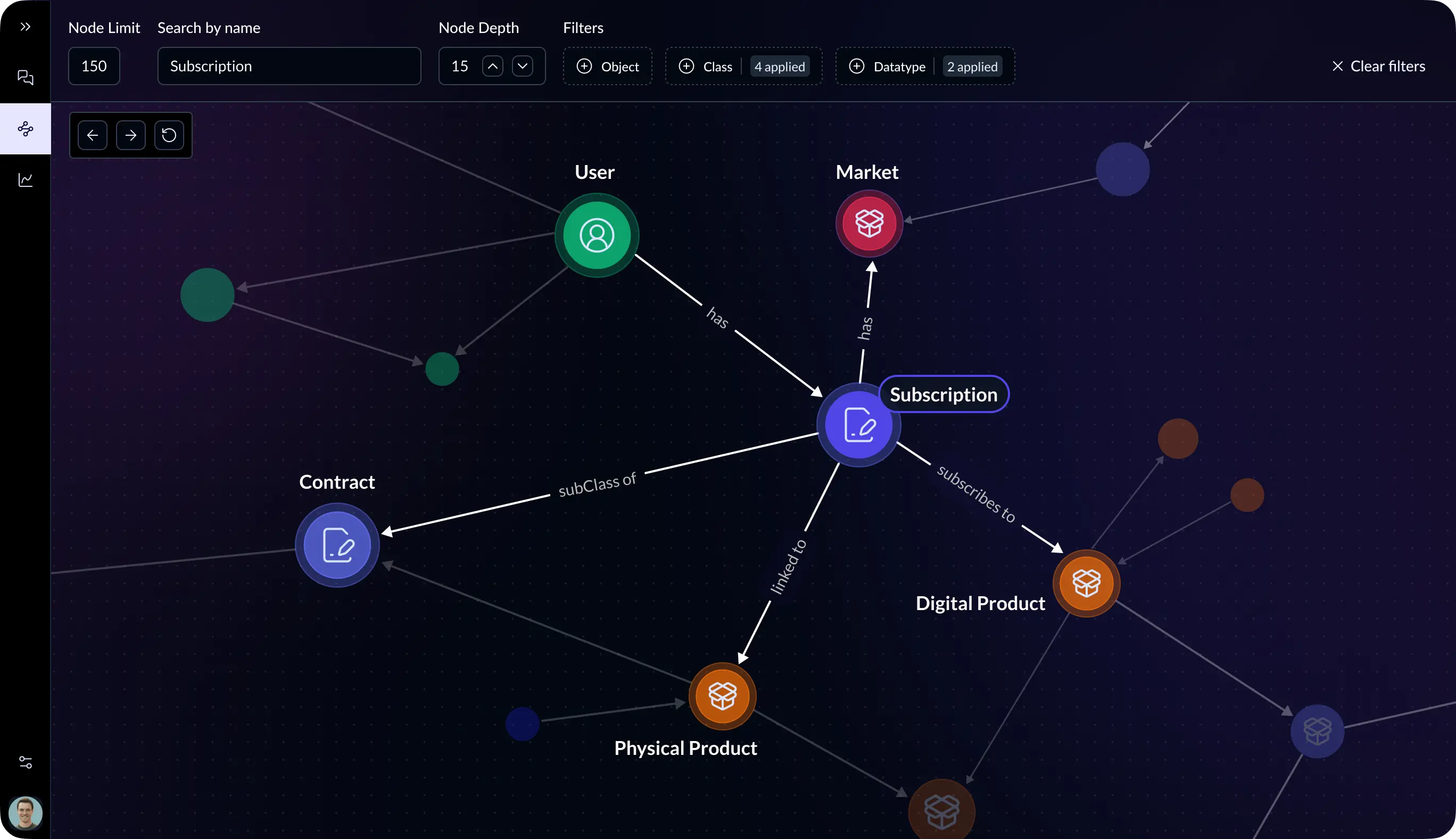
d.AP ensures AI operates on enterprise knowledge and not hallucinated patterns.
Here's how:
- Explicit semantics and relationships
- Governed reasoning paths
- Human-understandable explanations

Designed to Work With Your Existing Data Fabric
- No pipeline replacement
- No ingestion duplication
- Works across domains and platforms
- Built on open standards (RDF/OWL)
Who This Knowledge Layer Is Built For
Enterprises already investing in data fabrics
Data / AI leaders pursuing scalable AI
Organizations struggling with explainability
Leaders accountable for decision quality
Frequently Asked Questions
We answer your questions in advance. We've missed something? Let us know.
We already have a data fabric. Why do we need this?
.svg)
A data fabric connects and orchestrates data, but it does not define what that data means or how decisions should be derived from it. d.AP sits above the data fabric as a knowledge layer, modeling entities, relationships, and constraints so connected data can actually be used for decisions.
How is this different from semantic layers in BI tools?
BI semantic layers optimize reporting within a tool. d.AP creates enterprise-wide semantics that span across domains, are reused across BI, applications and AI, and support reasoning and explainability.
Why can’t AI just query the data fabric directly?
Because AI needs grounded meaning, not just access to data. d.AP provides explicit semantics and relationships, ensuring AI answers are derived from enterprise knowledge, not hallucinated patterns.
Everyone promises ‘AI readiness’. What’s different here?
Most platforms make data accessible to AI. d.AP makes data understandable to AI by encoding meaning explicitly, governing reasoning paths, and ensuring answers can be traced back to logic.
Does this replace or interfere with our data fabric?
No. d.AP does not replace data pipelines, iIngestion layers or fabric orchestration. d.AP consumes from it and adds decision context, not data movement.
Will d.AP slow us down?
No. It accelerates decisions. dAP removes the bottlenecks present in data fabrics (manual interpretation, repeated analysis, unclear assumptions) to improve decision speed.
How do users actually get answers using d.AP?
End users interact through Aluna, a natural-language interface grounded in the knowledge layer. Users ask questions in plain English and receive non-hallucinatory answers directly.