
Semantic Digital Twin Built for Real Enterprise Decisions
A living, explainable Digital Twin that mirrors how your enterprise actually works across systems, teams, and time.
- Live Digital Twin across operational systems
- Ontology-driven, not dashboard-driven
- Explainable decisions, not black-box AI
- Built for complex, regulated enterprises
Enterprise-only demos · Real decision scenarios · No generic walkthroughs

Why Most Digital Twins Fail at Decision-Making
Most Digital Twins were built to simulate assets or processes and not to support real enterprise decisions. In practice, enterprises face:
- Static models that drift from reality
- Dashboards that show metrics without meaning
- AI answers that cannot be explained or trusted
- Decisions slowed by fragmented systems
Decisions don’t fail because data is missing. They fail because meaning is fragmented.

Not just a simulation engine or analytics layer.
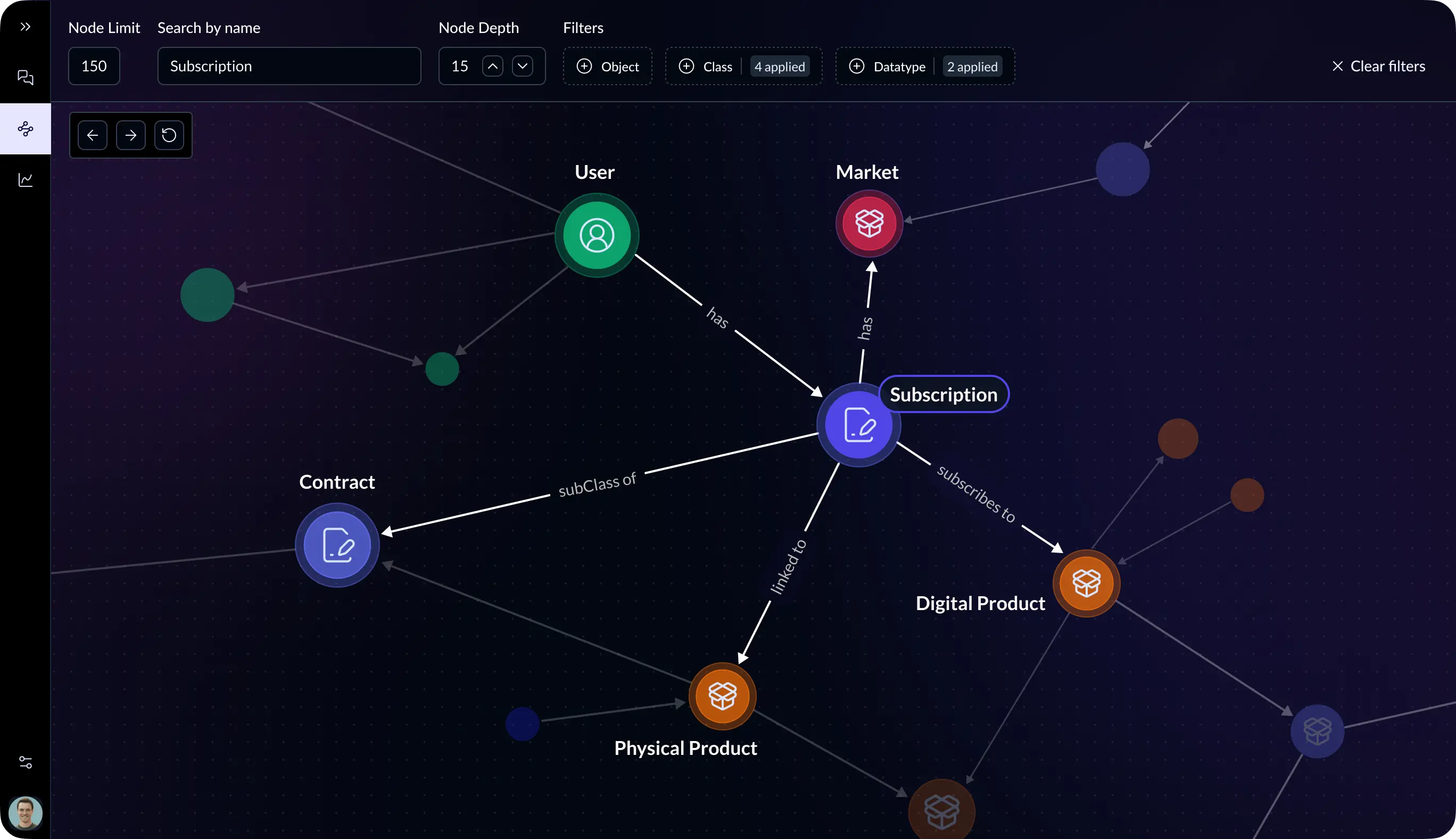
d.AP’s Digital Twin is built on an enterprise Knowledge Graph that represents entities, relationships, and rules across systems ~ creating a living model of how the organization actually operates.
Users may query the Digital Twin via Aluna, allowing decision-makers to ask “what if” and “why” questions in plain English. Answers are grounded in the underlying Knowledge Graph.
This is not analytics. It’s decision infrastructure.
Traditional Digital Twin
- Static or simulated models
- Asset or process-focused
- Disconnected from live decisions
d.AP Digital Twin
- Live, semantic enterprise model
- Decision-focused
- Explainable by design

Step 1: Federated System Connectivity
Operational systems stay where they are. d.AP connects live via federated integration.

Step 2: Enterprise Ontology
Business concepts and rules are modeled once, reflecting how the organization actually operates.

Step 3: Reasoning & Explainability
Decisions are derived through meaning, relationships, and rules.

Step 4: Decision Consumption
Humans and AI agents access the same trusted enterprise knowledge.
Real enterpise impact.


Questions d.AP Can Help Answer ~ Reliably
Where are we losing margin across the customer lifecycle and why?
Which regions will miss targets this quarter, and what’s driving it?
What are the root causes behind operational delays right now?
Where can we reduce cost without increasing risk?
Every Decision Is Explainable
- Data sources are visible
- Logic and assumptions are inspectable
- Decisions are auditable and defensible
Built for regulated and high-stakes environments.

Designed for Fast, Low-Risk Adoption
- EU-hosted SaaS (VPC)
- Customer-managed cloud (PaaS)
- Pilot-first engagement model
Built for Enterprises Where Decisions Matter
Large enterprises with multi-system environments
Established Data / AI teams
High-impact, cross-functional decisions
Strong explainability and compliance requirement
Frequently Asked Questions
We answer your questions in advance. We've missed something? Let us know.
Why do we need a Digital Twin if we already have analytics and AI tools?
.svg)
Analytics reports metrics. AI generates probabilistic answers. Our Digital Twin provides the semantic representation of enterprise reality both depend on. Without structured enterprise knowledge, neither scales reliably.
Is this a simulation-based Digital Twin?
No. d.AP does not rely on hypothetical simulations or static models. It operates as a live Digital Twin, grounded in real operational data and business logic. Decisions are derived from current enterprise reality, not approximations or pre-defined scenarios.
How does d.AP ensure decisions are explainable and trustworthy?
Users can inspect every answer d.AP produces, including which systems contributed data, what logic, rules, and relationships were applied, and how conclusions were derived.
Can non-technical users work with d.AP?
Yes. Business users interact with d.AP through natural language using Aluna, d.AP’s AI assistant. No SQL, SPARQL, or data engineering skills are required. The system translates questions into formal queries while preserving semantic accuracy and explainability.
How does d.AP connect to our existing systems?
d.AP uses a federated integration approach. Data stays where it is. Systems are connected through semantic mappings using open standards, supporting zero-ETL or hybrid models depending on performance and governance requirements.
Is d.AP suitable for regulated or sensitive environments?
Yes. d.AP supports: EU-hosted SaaS deployments; Customer-managed cloud (PaaS); Fine-grained access control; Full auditability and traceability.
How do users actually extract insights or data from the Digital Twin?
Users don’t extract raw data manually. They interact with the Digital Twin through Aluna, d.AP’s natural-language AI decision assistant.