
Semantic Data Platform for Enterprise Decisions
Expose enterprise data through shared meaning and logic, enabling trusted answers across BI, analytics, AI, and applications.
- One semantic layer shared across BI, AI, and operational systems
- Explicit business meaning instead of hidden dashboard logic
- Runtime semantic access with full explainability
- Built for complex enterprise data landscapes
Enterprise use cases only · No BI-only demos · Real decision scenarios

Why Semantic Data Access Has Become an Enterprise Problem
Enterprises rarely struggle to store or process data anymore.
They struggle to access data through consistent meaning.
In practice, this leads to:
- Semantic logic trapped inside BI tools
- KPI definitions drifting across teams
- Transformation logic duplicated across pipelines
- AI consuming raw schemas instead of business meaning
- Trust eroding because answers cannot be explained
Decisions don’t fail because data is missing. They fail because meaning is fragmented.

Not Just a BI Semantic Layer
Most semantic approaches today are embedded inside specific tools.
BI platforms define semantics for dashboards. Data pipelines define semantics for transformations. But neither exposes enterprise meaning consistently across all consumers.
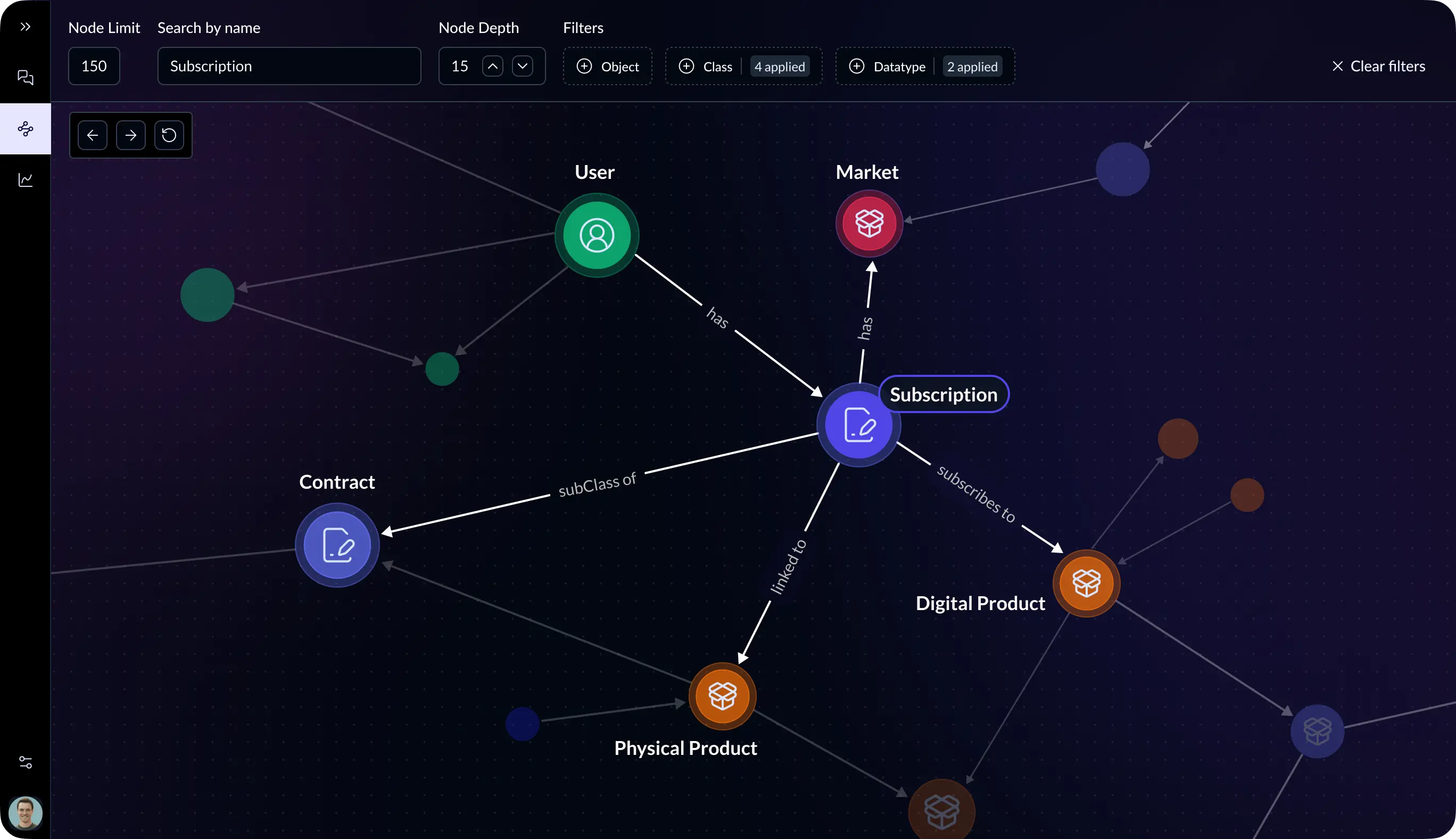
d.AP provides a tool-independent semantic access layer implemented as an enterprise Knowledge Graph, where entities, relationships, and constraints are modeled explicitly.
Users interact with this meaning through Aluna, asking questions in plain English and receiving answers derived from enterprise semantics.
This is not analytics tooling. It’s semantic access infrastructure.
Generic Semantics Approach
- BI-embedded semantics
- Query abstraction without deep meaning
- Limited reuse outside tools
d.AP Semantic Data Platform
- Ontology-grounded semantics
- Runtime access across consumers
- Explainable and reusable by design

Step 1: Federated Data Access
Data remains in existing warehouses, lakes, and operational systems. d.AP connects through federation and maps source data to the knowledge graph.

Step 2: Semantic Modeling (Ontology)
Business entities, metrics, and relationships are modeled explicitly in a Knowledge Graph, creating a shared semantic foundation reused across BI, AI, and applications.

Step 3: Knowledge Graph Resolution & Reasoning
Queries are resolved through the knowledge graph’s semantic structure. Entities, relationships, and constraints rather than through hard-coded transformations.

Step 4: Consumption Everywhere
The same semantic knowledge can be accessed by BI tools, APIs, AI systems, applications, or through Aluna, which translates natural language questions into ontology-grounded queries.
What an Enterprise Semantic Data Platform Enables.
Consistent Metrics Across Teams
Metrics and definitions are modeled once in the knowledge graph and reused across BI, analytics, AI, and applications.
Faster Time to Insight
Teams access trusted answers directly without repeatedly rebuilding metric logic across dashboards and pipelines.
Higher Trust in Decisions
Every metric and answer is grounded in explicit semantic definitions, with full traceability back to source systems.


Questions Teams Can Answer with Semantic Access
Where are we losing the most margin across the customer lifecycle and why?
Where can we reduce cost without increasing operational or compliance risk?
Which operational bottlenecks are impacting revenue across systems right now?
Which regions or product lines will miss targets this quarter, and what’s driving it?
Explainability Built into the Knowledge Graph
Because meaning and logic are modeled directly in the knowledge graph:
- Metric definitions are inspectable
- Source systems are visible
- Transformations and assumptions are traceable
This ensures answers remain explainable and defensible, even in complex enterprise environments.

Designed for Enterprise Data Landscapes
- SaaS deployment (EU-hosted VPC)
- Customer-managed cloud (PaaS)
- Coexists with existing BI tools and data platforms
Who is dAP built for?
Enterprises with mature data stacks
Teams struggling with metric consistency and reuse
Organizations running BI, analytics, and AI on shared data
Enterprises that require explainable answers
Frequently Asked Questions
We answer your questions in advance. We've missed something? Let us know.
How is d.AP different from BI semantic layers (Looker, Power BI, etc.)?
.svg)
BI semantic layers are tool-bound. Their logic lives inside dashboards and cannot be reused reliably outside that tool. d.AP provides a tool-independent semantic access layer, allowing the same business meaning to be reused across BI, analytics, AI, and applications without redefining metrics in every tool.
Does d.AP replace our data warehouse, lake, or BI tools?
No. d.AP is not a replacement for your existing data platforms or BI tools. It sits above them as a semantic access layer, exposing consistent meaning and logic while your current stack continues to handle storage, compute, and visualization.
Why isn’t our existing data model or dbt setup enough?
Transformation-based approaches (including dbt) define semantics inside pipelines, not at access time. This limits reuse outside analytics, makes AI consumption difficult, and creates duplication as new use cases emerge. d.AP separates semantic meaning from transformation logic, making it reusable across consumers.
How does d.AP help with metric inconsistency and trust issues?
d.AP defines metrics and logic once, at the semantic layer. Every consumer (BI, AI, or application) accesses the same definitions, with full visibility into how results are calculated. This eliminates silent drift and “competing truths.”
Can AI and LLMs safely consume data through d.AP?
Yes. d.AP exposes structured, explainable business meaning, not raw schemas. This makes it suitable for AI and agent-based use cases where answers must be grounded, traceable, and consistent and avoiding hallucinations caused by unstructured access.
Who owns semantic logic over time?
Semantic ownership is explicit in d.AP. Enterprises typically assign ownership jointly between domain teams (meaning) and data teams (implementation), avoiding the “logic hidden in dashboards” problem common in BI-led approaches.
Is this suitable only for highly regulated industries?
No, but regulated industries benefit most. d.AP is built for environments where trust, traceability, and explainability matter. Enterprises outside regulated sectors adopt it to reduce rework, speed up decisions, and enable AI safely.