
Healthcare Knowledge Graph for Clinical & Operational Decisions
d.AP connects siloed clinical, operational, and research data into a shared model of meaning that enables faster decisions and explainable AI insights.
- Connect clinical, operational, and research data
- Understand relationships across patients, treatments, and outcomes
- Enable explainable AI insights through Aluna
- Improve clinical and operational decision-making
Healthcare use cases • Architecture walkthrough • No infrastructure replacement

Why Healthcare Data Alone Doesn’t Deliver Clinical Insight
Healthcare organizations generate enormous volumes of data across:
- Electronic health records
- Clinical systems
- Research platforms
- Operational systems
Yet understanding how patients, treatments, outcomes, and operational processes relate to each other remains difficult.
Because while the data exists, the relationships between these elements are rarely modeled explicitly.
Healthcare insight lives in relationships. Healthcare insight lives in relationships.

From Fragmented Healthcare Data to a Unified Knowledge Graph
Traditional healthcare data platforms focus on storing or moving data.
d.AP focuses on modeling relationships and meaning.
The platform builds an ontology-grounded Knowledge Graph representing:
- Patients and treatments
- Clinical outcomes
- Healthcare processes
- Research knowledge
This shared model allows healthcare teams and AI systems to reason across clinical and operational data.
Traditional Healthcare Data Platforms
- Data fragmented across systems
- Relationships inferred manually
- Clinical analysis recreated repeatedly
Healthcare Knowledge Graph with d.AP
- Explicit clinical relationships
- Shared healthcare context
- Reusable reasoning across teams

Step 1: Data Integration
Clinical systems, research platforms, and operational systems connect into the Knowledge Graph.

Step 2: Ontology Modeling
Healthcare entities and relationships modeled explicitly across patients, treatments, diagnoses, clinical processes.

Step 3: Knowledge-Based Reasoning
Relationships and constraints allow reasoning across patient care pathways and operational processes.

Step 4: Explainable AI via Aluna
Healthcare teams ask questions in natural language and receive answers grounded in clinical knowledge.
Real results, real impact.
Holistic Patient and Clinical Insight
Understand relationships between patients, treatments, outcomes, and care pathways.
Explainable AI for Healthcare Decisions
Aluna delivers answers grounded in the Knowledge Graph so clinical insights remain transparent and trustworthy.
Faster Clinical and Operational Analysis
Trace relationships across systems and datasets without weeks of manual investigation.


Questions d.AP Can Help Answer ~ Reliably
How are these treatments connected to patient outcomes?
Which factors contributed to this clinical result?
What relationships exist between diagnoses, treatments, and recovery patterns?
How do operational processes impact patient care?
Ask Questions. Get Explainable Clinical Insights.
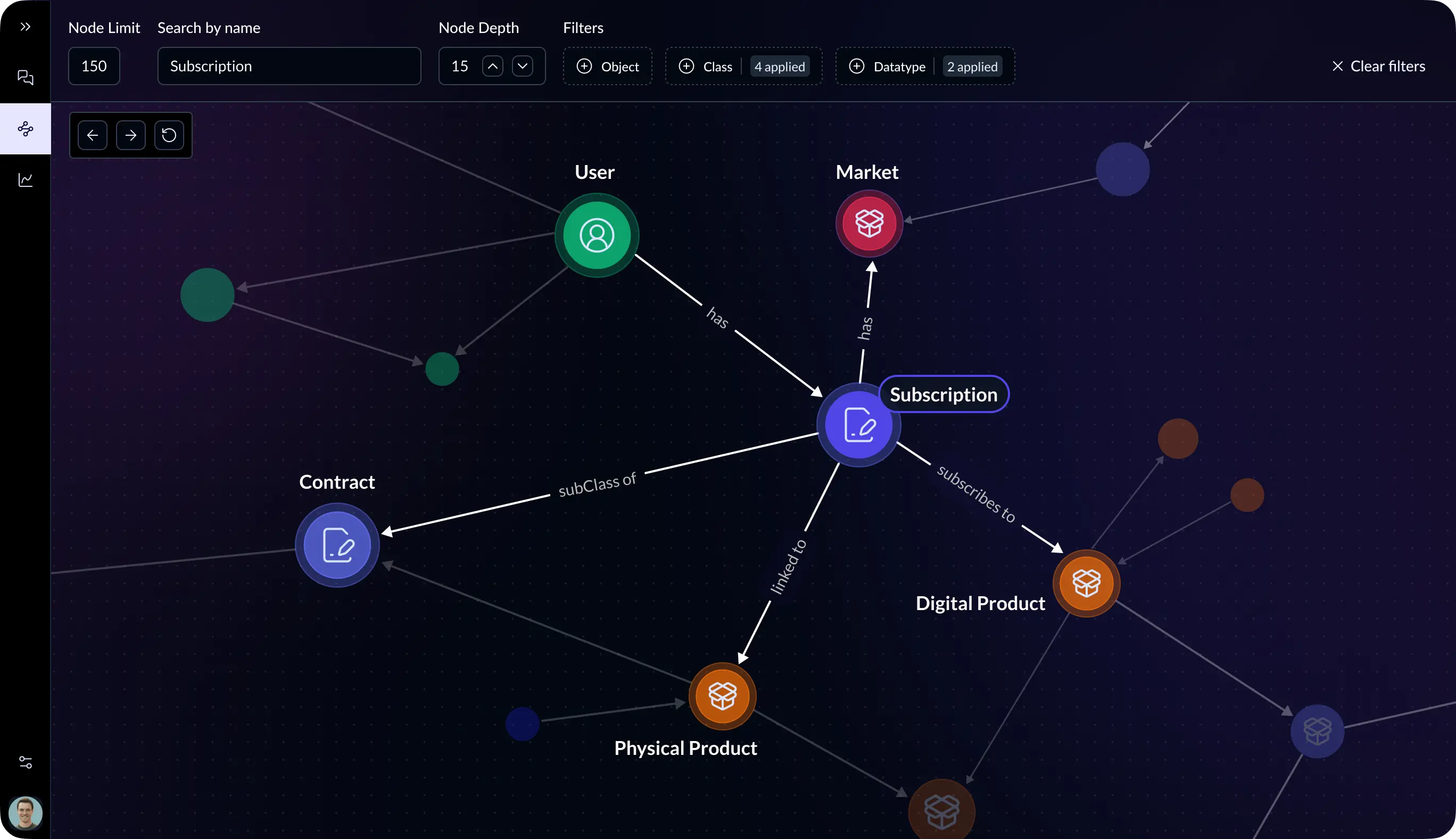
d.AP exposes the healthcare Knowledge Graph through Aluna, enabling teams to ask complex healthcare questions in natural language.
Aluna returns answers grounded in enterprise knowledge.
Every answer is:
- Derived from the Knowledge Graph
- Grounded in healthcare ontologies
- Traceable to relationships and evidence
This enables AI-driven healthcare analytics without sacrificing trust or explainability.

Designed for Healthcare Enterprise Architectures
d.AP integrates with existing healthcare systems and analytics platforms.
Deployment options include:
- EU-hosted SaaS (VPC)
- Customer-managed cloud environments
- Hybrid deployments
Organizations typically begin with a focused domain such as clinical data relationships, patient pathways, or operational analytics.
Who d.AP is for
Healthcare data architecture teams
Clinical analytics leaders
High-impact, cross-functional decisions
Strong explainability and compliance requirement
Frequently Asked Questions
We answer your questions in advance. We've missed something? Let us know.
How is d.AP different from analytics or BI platforms? ---
.svg)
Analytics platforms report on data after it has been modeled and aggregated. d.AP operates above analytics, as a decision layer. It understands meaning, relationships, and logic across systems, allowing users to ask complex, cross-domain questions and receive explainable answers.
Is d.AP replacing our existing data platform or BI stack?
No. d.AP does not replace Databricks, Snowflake, SAP, Salesforce, or BI tools. It sits on top of your existing systems as the missing knowledge layer, connecting them through meaning so decisions can span systems without re-engineering your stack.
Our healthcare analytics platforms already provide reporting. Why introduce a knowledge graph layer?
Traditional healthcare analytics platforms analyze individual datasets but often lack a shared model of how clinical entities relate to one another. d.AP creates a knowledge layer that connects patients, treatments, diagnoses, and outcomes, allowing teams to reason across healthcare data rather than analyzing it in isolation.
How does d.AP support AI initiatives in healthcare?
d.AP provides the structured knowledge foundation required for trustworthy AI. Through Aluna, users can ask questions in plain English and receive answers derived from the Knowledge Graph, ensuring insights are grounded in clinical relationships rather than probabilistic guesses.
Can d.AP scale across large healthcare organizations and multiple systems?
Yes. d.AP is designed for enterprise environments where data spans clinical systems, operational platforms, and research environments. Its Knowledge Graph architecture allows organizations to model and reason across large, interconnected healthcare datasets.