
Turn RDF Databases into Decision-Ready Knowledge
d.AP sits above RDF databases to model meaning, relationships, and constraints. End users access this data to get trusted answers via explainable AI (Aluna).
- Works with existing RDF databases (no replacement)
- Adds ontology-grounded meaning and reasoning
- Enables explainable AI answers via Aluna
- Designed for enterprise decision-making, not storage
Built for enterprise RDF stacks · No database migration · Architecture-led demos

Why RDF Databases Alone Don’t Deliver Business Answers
RDF databases excel at storing semantic data and enabling flexible graph queries.
But in practice, organizations still struggle to turn RDF knowledge into business answers.
Enterprises often face:
- Knowledge that remains accessible only to engineers
- SPARQL queries that expose data but not decisions
- AI systems that lack structured reasoning paths
- Business users unable to interact directly with semantic knowledge
Decisions don’t fail because data is missing. They fail because meaning is fragmented.

RDF Databases vs Decision-Ready Knowledge
RDF databases are powerful semantic storage engines.
But storing triples does not automatically make knowledge usable for decisions.
d.AP sits above RDF databases as a knowledge and reasoning layer.
It models enterprise meaning, enforces constraints, and exposes answers in a way humans and AI systems can actually use.
d.AP turns RDF knowledge into decision infrastructure.
RDF Databases
d.AP Knowledge Layer

Step 1: RDF Database Integration
Existing RDF databases remain systems of record.

Step 2: Ontology-Grounded Modeling
Meaning, entities, and relationships are defined explicitly.

Step 3: Knowledge-Based Reasoning
Reasoning is applied across RDF-backed knowledge.

Step 4: Explainable Access via Aluna
Users ask questions in plain English; answers are derived, not generated.
What Enterprises Gain from their RDF Databases with d.AP.
Shared Enterprise Knowledge
Semantic knowledge stored in RDF becomes accessible across teams, not just engineering.
Explainable AI Answers
Aluna derives answers from RDF-grounded knowledge and ontology rules, eliminating hallucination.
Faster, More Reliable Decisions
Decision-makers gain trusted answers without needing SPARQL queries or manual interpretation.


Questions Your RDF Knowledge Graph Should Be Able to Answer
Where are we losing revenue across our customer lifecycle and why?
Which operational dependencies are creating downstream risk?
Which regions will miss targets this quarter and what’s driving it?
Where can we reduce cost without increasing operational risk?
Explainable AI on Top of RDF Knowledge
d.AP exposes RDF-backed knowledge through Aluna, a natural-language decision interface.
- Aluna translates questions into ontology-grounded queries
- Answers are derived from RDF knowledge and reasoning rules
- Every result includes inspectable reasoning paths
Aluna turns RDF knowledge into answers people can actually understand, use, and defend.

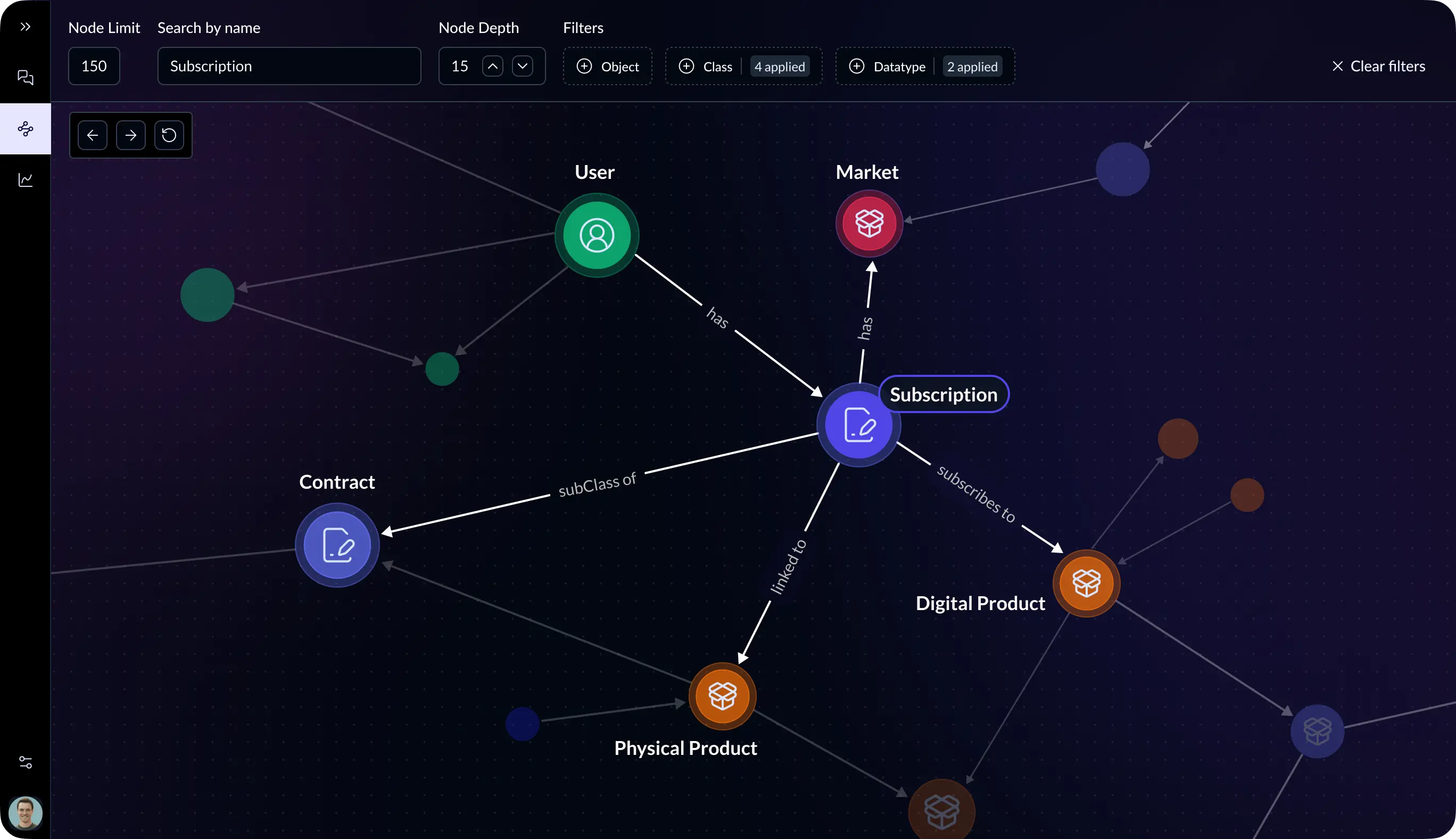
Designed for Existing RDF Architectures
- No RDF database replacement
- Supports multiple RDF stores
- Incremental adoption
Who This RDF Knowledge Platform Is Built For
Enterprises using RDF or semantic technologies
Data and AI teams building knowledge graphs
Organizations pursuing explainable AI
Architects responsible for enterprise decision systems
Frequently Asked Questions
We answer your questions in advance. We've missed something? Let us know.
Is d.AP an RDF database?
.svg)
No. d.AP is not an RDF database. d.AP sits above RDF databases as a knowledge and explainability layer, adding meaning, reasoning, and human-accessible answers on top of existing RDF data.
Does this replace our existing RDF database or triple store?
d.AP is designed to work with existing RDF databases, not replace them. d.AP consumes RDF-backed knowledge and makes it usable beyond engineering teams.
How does d.AP work if we have multiple RDF databases?
d.AP can integrate with multiple RDF databases and semantic sources. It unifies them into a single, coherent Knowledge Graph layer and avoids fragmentation while preserving existing architectures.
How does Aluna avoid hallucination?
Aluna does not generate answers freely. Questions are translated into ontology-grounded queries, answers are derived from RDF-backed knowledge and rules, and reasoning paths are explicit and inspectable.
Is this just a chatbot on top of RDF?
No. Aluna is an explainable AI capability built specifically for enterprise knowledge graphs. It is constrained by ontologies, governed relationships, and explicit reasoning logic.
Do users need to write SPARQL queries to work with RDF data in d.AP?
No. Users interact with RDF-backed knowledge through Aluna, d.AP’s natural-language interface. Questions are translated into ontology-grounded queries automatically, and answers are returned as tables, dashboards, or relationship views with fully inspectable reasoning.
Can d.AP work with multiple RDF databases or knowledge graphs?
Yes. d.AP can integrate multiple RDF stores and semantic sources into a unified knowledge layer while leaving each system in place. Ontologies ensure entities and relationships are interpreted consistently across datasets, enabling cross-domain answers without consolidating databases.