
Palantir Foundry is often shortlisted when organizations need more than dashboards or a traditional analytics stack. It’s built for complex enterprise environments where data is distributed across ERPs, operational systems, spreadsheets, and cloud warehouses - and where teams need governed access, traceability, and operational workflows that connect data to action.
However, more buyers are reassessing whether a single, monolithic platform is the right long-term operating model. Common drivers include total cost of ownership (licensing, implementation, and ongoing platform engineering), concerns around proprietary semantics and long-term portability, and rising expectations for explainability and auditability as AI becomes embedded in decision-making - particularly in regulated industries.
In this guide, we outline what makes Foundry distinctive, why enterprises evaluate alternatives, and how leading platforms compare across architecture, semantic capabilities, compliance constraints, and time-to-value. While most evaluations are replacement-driven, some organizations adopt phased transitions where multiple platforms coexist during migration, depending on risk, scope, and existing investment.
TL;DR: the 8 best Palantir Foundry alternatives in 2026:
- d.AP by digetiers: Ontology-grounded knowledge layer and decision intelligence on open standards (RDF/OWL), designed for explainable reasoning
- Databricks: Lakehouse + ML engineering for big data and machine learning at scale
- Snowflake: Cloud-based data warehousing and analytics with strong governance foundations
- Microsoft Fabric: End-to-end analytics platform with OneLake + semantic models + BI
- Informatica (IDMC): Enterprise data integration, quality, cataloging, and governance across hybrid/multi-cloud
- Denodo: Data virtualization / logical data management for fast federation across systems
- Dataiku: Collaborative data science and ML workflows, from experimentation to deployment
- C3 AI: Pre-built enterprise AI applications and workflows for operational use cases
What is Palantir Foundry & Why Do Enterprises Look for Alternatives?
Foundry’s core differentiator is its ontology-first operating model: it treats semantics as infrastructure, modeling operational domains (entities, relationships, and logic) and using that model to deliver governed workflows and applications - not just analytics. Buyers often choose it for end-to-end operational decisioning in complex, controlled environments.
However, many organizations reassess due to operating-model complexity, concerns around proprietary semantics and portability, and rising requirements for explainability and auditability as AI moves into production decision flows.
What makes Foundry unique?
Foundry is distinctive because it treats semantics as infrastructure. Its Ontology layer standardizes core business entities and relationships, which makes it easier to build operational workflows and applications with governance and traceability baked in, rather than stitched together across tools.
Why teams reassess Palantir Foundry
Even where Foundry performs well, organizations often reassess their commitment based on their operating model rather than just raw capability.
- High TCO and procurement friction: A common trigger. Foundry is a serious enterprise commitment. For narrower use cases - like a single department or a pilot - the cost and rollout effort often outweigh the immediate benefit.
- Proprietary semantics and lock-in: If your key business definitions live inside a proprietary ontology, the cost of switching later is huge. You aren't just moving data; you are trying to move the meaning of that data.
- Platform engineering dependency: Ontology-based systems create immense value, but they are also a new asset that must be maintained. Many organizations discover they need specialist engineers just to keep the "digital twin" healthy.
- Auditability and the EU AI Act: As EU AI regulation rolls out progressively through 2025–2027, governance expectations around documentation, traceability, and risk controls are rising. For many buyers, this increases the value of platforms where logic and lineage can be inspected and defended in production decision flows.
Evaluating the alternatives: a simple framework
If you compare Foundry with alternatives using a generic feature checklist, you will get misleading results. A better approach is to evaluate them using the criteria that actually affect your cost, compliance, and operations.
- Semantic Modelling: Can the platform represent business entities and relationships (not just schemas)?
- Explainability: Can you trace a recommendation back to the specific rule or data point that triggered it?
- Governance: Can you control access at a granular level?
- Business-User Accessibility: Can non-engineers find answers without logging a ticket?
- AI and GenAI enablement: Does the platform offer grounded, production-ready infrastructure for LLMs and agents, or merely experimental sandboxes?
- Integration: Does it play nicely with your existing cloud stack, or try to replace it?
- Time-to-Value: Does it take months to prove value, or weeks?
- Deployment & Compliance: Does it meet strict data residency requirements (crucial for EU entities)?
- Total cost of ownership: Look beyond the license fee to capture the hidden burden of infrastructure, specialist engineering, and long-term maintenance.
Quick Decision Shortcuts
- If semantics and explainability are core → d.AP
- If engineering-led ML scale matters most → Databricks
- If analytics-centric workflows dominate → Snowflake / Fabric
- If federation (no data movement) is critical → Denodo
Decision matrix: Palantir Foundry alternatives compared
Use this matrix as a quick overview. It’s designed to help you shortlist - then validate with demos and architecture discussions.
- Rows represent criteria buyers actually use
- Columns represent Foundry and its closest alternatives
- Values are descriptive (not scored) to reduce false precision
The Best Palantir Foundry Alternatives in 2026
1. d.AP
Best for: Sovereign, ontology-driven operational intelligence.
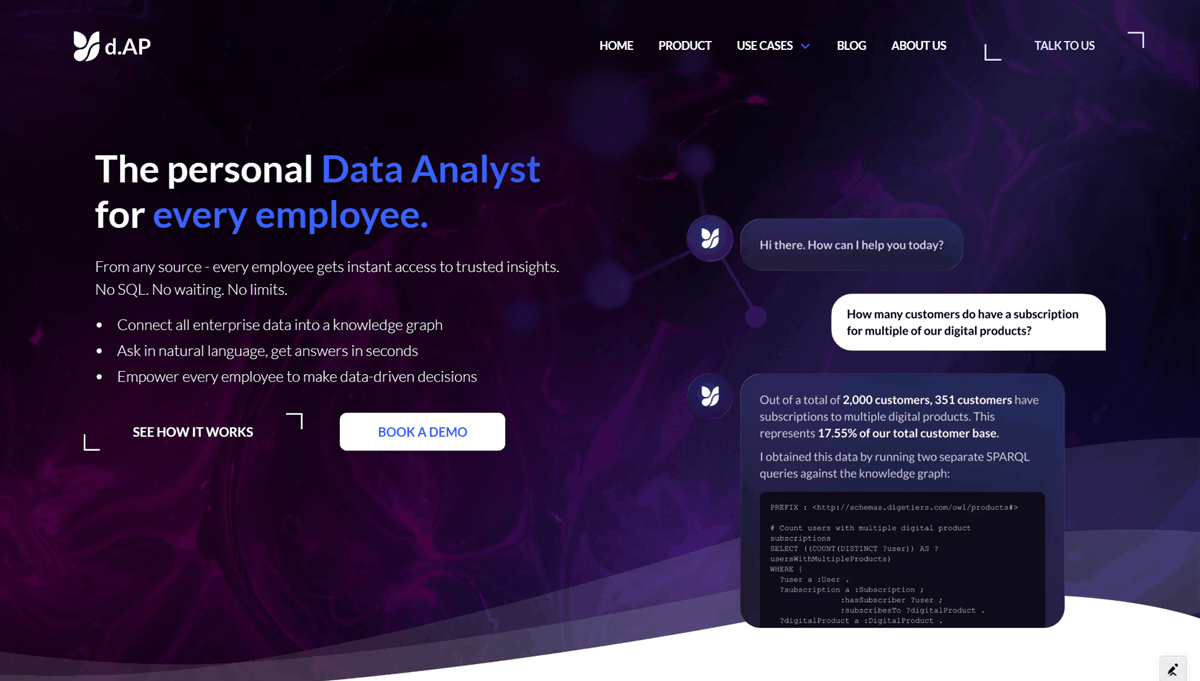
d.AP is the direct architectural alternative to Palantir Foundry for enterprises that want ontology-driven operational intelligence while reducing long-term lock-in risk. It functions as a Knowledge Organization System, structuring enterprise data so it becomes usable for AI, agents, and humans. By grounding outputs in explicit business entities, relationships, and rules, it helps reduce hallucination risk and improves auditability in regulated contexts.
Unlike Foundry, which locks logic inside a proprietary environment, d.AP leverages Open RDF/OWL standards. This decoupling ensures you own your semantic model - your institutional knowledge - independent of the software running it. By sitting above your existing systems, d.AP transforms fragmented information into a machine-readable knowledge graph, reducing hallucination risk by grounding outputs in explicit entities/relationships/rules.
How It Works: The Knowledge Organization System
d.AP does not just store data; it organizes knowledge. Its architecture follows a high-level flow:
- Federation: Instead of requiring a massive proprietary ingestion lift, d.AP federates data from existing systems (connecting to Snowflake, SAP, Salesforce, etc.).
- Ontology Mapping: It maps this raw data to a shared business ontology using Open RDF/OWL standards. This converts technical schemas into business concepts (e.g., mapping "T_KUN_01" to "Active Customer").
- Live Knowledge Graph: These concepts are linked into a live graph, enabling complex querying across systems (e.g., "Show all orders impacted by the delay in Plant B").
- Explainable Reasoning: The platform delivers insights through AI agents and dashboards where every output is traceable back to the specific data and business rule that generated it.
When to Choose d.AP over Foundry
- Explainability is mandatory: You operate in a regulated sector (Finance, Pharma, Defense) where you must prove why a decision was made.
- You demand open standards: You want to avoid vendor lock-in and ensure your ontology remains your asset.
- Time-to-Value is critical: You need to answer cross-system questions in weeks, not months, without a heavy platform engineering dependency.
Choose d.AP when
- You want the operational power of an ontology without the 7-figure proprietary lock-in.
- Explainability/auditability is increasingly required by internal risk teams and regulators in regulated contexts.
- You require a platform where business users can self-serve intelligence, not just request dashboards from engineers.
d.AP is typically used in environments where teams need consistent meaning across systems and the ability to trace decisions back to trusted inputs. That often includes manufacturing and operations intelligence (where leaders need a real-time view of assets, production, and performance), pharma and life sciences decision support (where auditability matters as much as speed), and energy or other industrial analytics (where operations span complex, interconnected systems). It’s also a strong fit for enterprise KPI standardization across domains - especially when different teams define the “same” metric differently - and for regulated use cases where explainable AI is a requirement, not a nice-to-have.
2. Databricks: engineering-first lakehouse and ML at scale
Best for: Engineering-led Lakehouse architecture and ML scale.
Databricks leverages the "Lakehouse" paradigm to unify data warehousing and data lakes. It is commonly adopted for large-scale data engineering and machine learning model development.
Compared to Foundry, Databricks is less “ontology-first” and more “engineering-first”. It gives technical teams a lot of freedom, but that usually comes with a stronger requirement for engineering ownership.
Choose Databricks when
- You need ML and data engineering infrastructure at scale
- Your teams are Python/SQL-native
- You prefer open lakehouse patterns and flexible tooling
3. Snowflake: cloud analytics and data warehousing
Best for: Cloud data warehousing and SQL analytics.
Snowflake is a cloud data platform that brings together storage, processing, and analytics and is commonly used as the backbone for enterprise reporting and analytics stacks.
It’s widely adopted when the primary goal is to centralize analytical data access and analyse data using a mature SQL ecosystem.
Compared with Foundry, Snowflake is typically analytics-centric rather than operational. It doesn’t try to be an end-to-end operational decision platform; instead, it pairs with BI tools and (in more advanced stacks) semantic layers that provide business context.
Choose Snowflake when
- Data analysis and reporting dominate
- You want a mature SQL ecosystem
- You don’t need operational applications as part of the platform
4. Microsoft Fabric: unified analytics for Microsoft-centric organizations
Best for: Unified analytics within the Microsoft ecosystem.
Microsoft Fabric is positioned as an end-to-end analytics platform covering ingestion, transformation, real-time stream processing, analytics, and reporting.
It also includes OneLake, which Microsoft describes as a unified logical data lake for an organisation.
Fabric’s “semantic layer” is typically expressed through Power BI semantic models - Microsoft describes these as a logical description of an analytical domain with metrics and business-friendly terminology to enable deeper analysis.
Choose Fabric when
- You’re deeply invested in Microsoft (Azure, Power BI, Office ecosystem)
- You want consolidation across analytics experiences
- BI and analytics are the primary outcomes
5. Informatica (IDMC): enterprise integration and governance
Best for: Enterprise data governance and integration.
Informatica’s Intelligent Data Management Cloud (IDMC) is described as a cloud-native platform to discover, connect, and manage data across hybrid and multi-cloud environments. In practice, Informatica is often brought in when the main pain is data management: integration, data quality, cataloging, metadata management, and governance.
Compared to Foundry, Informatica is usually upstream: it helps make sure the data is trustworthy and well-governed, then other systems consume it for analytics, operational applications, or AI.
Choose Informatica when
- Data integration and governance are your top priorities
- You need robust enterprise controls across complex estates
- Analytics/AI is handled in other tools
6. Denodo: data virtualization and logical data management
Best for: Data virtualization and logical federation.
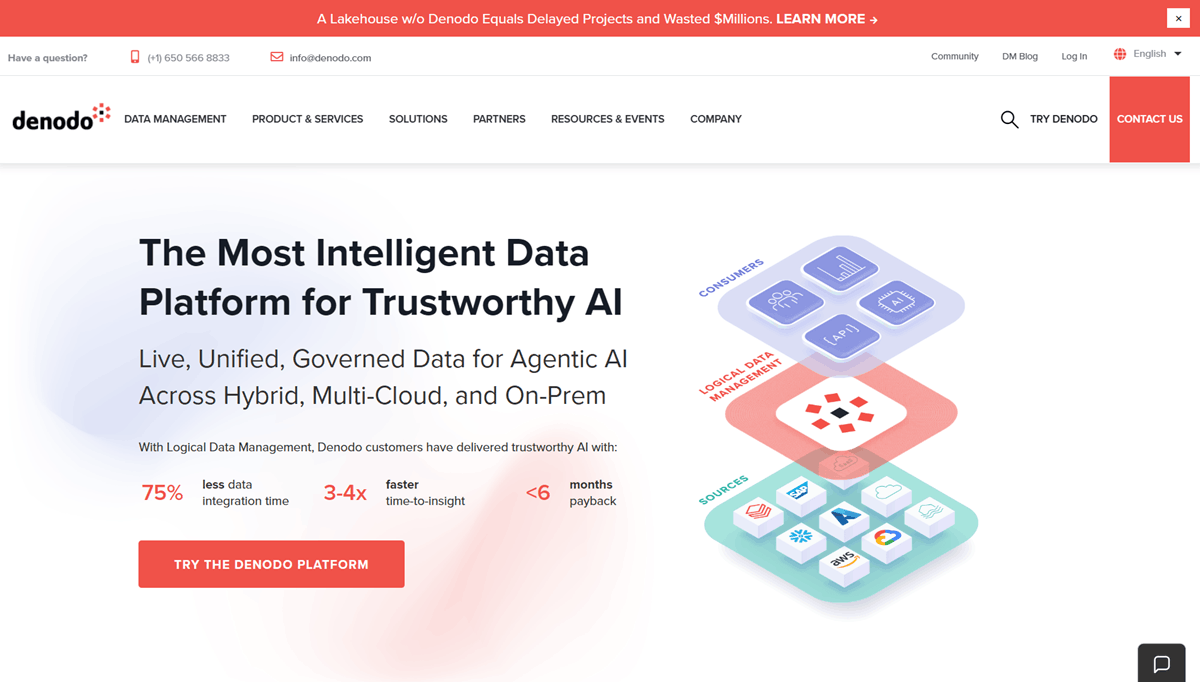
Denodo’s core value is data virtualization: establishing a single data-access layer that helps teams find and use enterprise data without moving it into one physical store. That makes it attractive when data movement is constrained by compliance, latency, cost, or operational complexity.
Compared to Foundry, Denodo is federation-first. It can reduce duplication and speed up access, but it doesn’t aim to provide ontology-driven operational decisioning on its own.
Choose Denodo when
- You need fast federation across many systems
- Data movement is heavily constrained
- You want a logical access layer across existing platforms
7. Dataiku: collaborative data science and ML workflows
Best for: Collaborative Machine Learning (MLOps).
Dataiku is often positioned as a platform to build and operationalize AI and ML, supporting both AutoML and deeper custom model development, while acting as a central place for deployment and management.
Compared to Foundry, Dataiku is typically model-centric: it helps teams collaborate on building ML outputs, but it doesn’t inherently standardise enterprise semantics the way ontology-first platforms aim to.
Choose Dataiku when
- ML experimentation velocity and collaboration are priorities
- Your “decision logic” largely lives in models
- You don’t need a unified operational data layer as the centre of the stack
8. C3 AI: pre-built operational AI applications
Best for: Verticalized, pre-built AI applications.
C3 AI offers enterprise AI applications and describes them as including prebuilt workflows and UI to accelerate deployment, alongside ML pipelines and extensible data models. It’s often most relevant in asset-heavy industries where packaged applications can deliver faster ROI than building everything from scratch.
Compared to Foundry, C3 AI is more application-forward: you choose a solution aligned to a known operational problem (reliability, demand forecasting, etc.), then extend it as needed.
Choose C3 AI when
- You want faster deployment via packaged applications
- Your use case matches a supported operational domain
- You prefer app deployment over building a horizontal platform
Use-case matchups
Manufacturing and operations: Foundry vs d.AP vs Databricks
If your priority is a fully integrated operational environment with deep custom workflows, Foundry can be a fit - especially when the organization is willing to invest in platform engineering to build and maintain the model.
If your priority is engineering-led streaming, anomaly detection, and ML at scale, Databricks tends to win on ML infrastructure and pipeline flexibility.
If your priority is explainable, auditable decision making that line operators and managers can trust -especially across systems - d.AP is the more direct fit (particularly where shared semantics and clarity matter as much as performance).
Regulated industries: Foundry vs d.AP vs “governance-led stacks”
In regulated industries, the technical question is rarely “can we do ML?” The real question is: can we explain decisions, preserve definitions, and maintain traceability when stakeholders (and auditors) ask “why?”
Some organizations use a governance-led stack (strong data management + warehousing + strict access control) and then add a knowledge layer to support explainable reasoning where required. d.AP is positioned directly around that gap: it makes meaning, logic, and business context first-class so AI can be reliable at scale
Analytics-heavy organizations: Foundry vs Snowflake/Fabric
If your organization’s daily work is analytics and reporting - finance, sales, BI-heavy functions - platforms like Snowflake or Fabric often deliver value faster. The work is typically: load data, model it, build dashboards, and iterate.
Foundry becomes more attractive when “analytics” is not the end goal - when the goal is operational applications, workflows, and governed action.
EU enterprises: Foundry vs d.AP (compliance lens)
For EU enterprises, the practical implication is that platforms that make meaning inspectable (semantics) and outcomes traceable (why a decision happened) are becoming more attractive - especially when AI is part of operational workflows.
Migration and coexistence patterns
A full Foundry replacement is usually the less common path once the platform is mature. The more realistic pattern in 2026 is complementing Foundry - keeping it where it works, while reducing risk and fragmentation across the wider enterprise stack.
Full replacement
This tends to happen when Foundry is underutilized, still early-stage, or the business case no longer holds:
- Adoption is shallow (limited operational apps)
- Cost and time-to-value no longer feel justified
- The organization wants open standards as a long-term foundation
Conceptually, migration often involves porting or remodeling semantic definitions into open standards where possible, reimplementing one operational domain first, and gradually moving pipelines and decision logic into the new target architecture.
Key risk: semantic drift - teams underestimate how much institutional knowledge lives in definitions and relationships, not in raw data.
Complementing Foundry
This is where most enterprises land, because it preserves prior investment and reduces migration risk.
A simple example you can describe:
- Foundry continues to power supply-chain operations
- d.AP sits above Foundry and non-Foundry systems
- d.AP provides a shared semantic layer and an explainable decision surface across domains
Why it matters
- Reduces migration risk
- Preserves what already works
- Avoids semantic fragmentation across tools
Preserving ontology-level knowledge
A critical error in platform migration is treating the ontology as if it were merely a schema. The distinction is fundamental: a schema defines how data is stored (tables, columns, types), whereas an ontology encodes what that data means.
An ontology captures the institutional knowledge that actually powers operations:
- Business Definitions: The precise logic defining a "churned customer" or "critical asset."
- Constraints: The operational rules governing validity and safety.
- Relationships: The complex, multi-dimensional dependencies between assets, people, and processes.
- Assumptions: The tacit context that raw data tables rarely capture.
The Risk of Semantic Loss When migrating away from a platform like Foundry, the primary risk is not losing the data, but losing the logic that makes the data usable. In proprietary environments, the ontology is frequently tightly coupled with the application layer.
Common Failure Modes
- Proprietary Embedding: Business meaning is locked inside platform-specific code rather than open standards, making it difficult to extract.
- Undocumented Context: Definitions exist only within the tool’s logic or the heads of a small technical team, with no external governance record.
- Inconsistent Recreation: The new target platform attempts to recreate definitions from scratch, leading to subtle variance in logic.
The Operational Consequence
If these definitions are not ported accurately, the organisation suffers from semantic drift. This manifests as conflicting KPIs (where the new system reports different numbers than the legacy one), a rapid loss of user trust, and significantly slower decision-making as teams are forced to validate data rather than act on it.
What good preservation looks like (conceptual best practice)
- Treat ontologies as long-lived assets
- Decouple semantic models from execution engines
- Use open standards (e.g., RDF/OWL) where possible
- Assign clear ownership for semantic changes
- Version and govern semantics like source code
Semantic ownership and governance risks
Platform migrations fail more often due to organizational ambiguity than technology. Even when pipelines are technically sound, projects collapse if teams cannot agree on what data represents.
Before migration, organizations should be able to answer:
- Who owns definitions? (e.g., Does "Gross Margin" belong to Finance or Sales?)
- Who approves semantic changes? (Is there a gatekeeper for altering the ontology?)
- Who arbitrates conflicts? (When teams disagree on logic, who has the casting vote?)
How are changes communicated? (Do downstream consumers know the definition changed?)
Common Failure Modes
Without clear governance, entropy takes over. A common scenario is that every tool defines core concepts like “customer” or “active asset” differently. While pre-built connectors can easily ingest data from Salesforce, SAP, and legacy ERPs, they cannot reconcile the conflicting business logic inherent in those source systems.
We also frequently see divergence between technical teams. ML engineers often embed specific logic into their models that diverges from the definitions used by BI teams to analyze data. The result is conflicting KPIs, where the "AI forecast" doesn't match the "Board report." When business teams see numbers that don't reconcile, they lose trust, and the platform is abandoned.
What to Recommend
The solution is central semantic ownership combined with decentralized execution. You do not need a single team writing every query, but you do need a single authority defining the ontology.
This requires a robust platform that makes semantics inspectable rather than hidden in code. Governance processes must ensure traceability from the final decision back to the data and the definition itself. Ultimately, this transparency helps users trust the system, providing an audit trail that explains not just what the number is, but why it is calculated that way.
Conclusion and recommendation
Palantir Foundry remains a powerful option for organizations that want an ontology-driven operational platform with strong governance - especially where security, complexity, and operational workflows justify a heavy platform commitment. Palantir’s own documentation makes clear that the Ontology is designed as an operational layer mapping integrated digital assets to real-world objects and relationships.
But in 2026, enterprise buyers are increasingly prioritizing modular architectures, faster time-to-value, and auditable decisioning as AI moves deeper into production workflows and governance expectations rise.
If semantic clarity, portability, and explainable decision intelligence are priorities - especially in regulated environments - d.AP is positioned as an ontology-grounded alternative. Book a demo to see how d.AP can replace Foundry for targeted domains, or support phased migration approaches where needed.