

Your data fabric has done much of what it was supposed to do. Data moves more easily across systems. Teams can access sources that used to be trapped inside separate platforms, and integration work is no longer as brittle as it used to be. You've successfully connected your distributed environments and automated data discovery using active metadata.
But the executive dashboard still shows three versions of revenue.
That's the gap this article addresses. A data fabric can connect data sources, expose data where it lives, and simplify data access. But it doesn't, by itself, create agreement on what customer, revenue, defect, asset, risk, or margin actually means to the business.
When you evaluate a semantic layer vs data fabric, you aren't looking at an either-or decision. A data fabric improves data movement. A semantic layer improves data interpretation. You need both if you want consistent business intelligence, trusted self-service analytics, and AI systems that can reason over enterprise data safely. The data fabric is the delivery mechanism; the semantic layer is the meaning layer that determines whether that fabric creates real BI value. It's the shift required to stop breaking your data bottlenecks from turning into a faster way to serve conflicting data.
The data fabric promise-and the BI gap leadership keeps hitting
A data fabric is a sound architectural direction for any sprawling enterprise data landscape. The problem is not that the fabric fails; it's that it solves a delivery problem, not a meaning problem.
What a data fabric actually delivers
A data fabric is an architecture that connects, integrates, and serves data across distributed data sources through a unified access layer. It's often supported by active metadata; metadata that's continuously analyzed to automate data discovery, data integration, governance, and data delivery.
A data fabric can reduce point-to-point data pipelines, improve data discovery, simplify data access, and give data consumers a more consistent route into data warehouses, data lakes, operational systems, and external data sources. It helps data engineers avoid building one-off integrations for every new request. It helps business users and analysts access relevant data faster, while supporting real-time data access, data virtualization, and more flexible data consumption across the modern data stack. But those gains are mostly about movement, connection, and access.
Why the fabric alone underdelivers on BI
More access to data doesn't automatically produce more consistent data interpretation. If ten systems define revenue differently, a data fabric can make all ten available faster. But unless those definitions are governed and resolved at the business level, the fabric simply exposes conflicting logic more efficiently.
Consider how revenue data drifts across your estate if left unmanaged:
- Sales may report revenue as gross after discounts to track deal momentum.
- Finance may report it net of returns to safeguard cash flow parameters.
- Controlling may report recognised revenue under IFRS 15 for regulatory compliance.
Each number can be valid in context, but a business intelligence tool still needs to know which definition applies to which question. Without a semantic layer, BI teams still spend time reconciling numbers. Data scientists still spend time interpreting technical data, and business users still question dashboards. AI agents inherit the same ambiguity and may return confident but unsupported answers.
The missing layer is not another integration pipeline. It's a shared layer of business meaning.
Where the semantic layer fits in a data fabric
The semantic layer sits between the fabric’s integrated data and the systems that consume it: BI tools, reporting tools, analytics tools, business users, data analysts, applications, machine learning models, and AI agents. It's the consumption-facing contract between data access and business meaning.
You can map the complete enterprise data flow into four clear layers:
- Consumption layer: BI tools, business users, AI agents
- Semantic control plane: Terms, metrics, relationships, rules
- Data fabric infrastructure: Active metadata, orchestration, data access
- Distributed storage: Data lakes, warehouses, live ERP/CRM systems
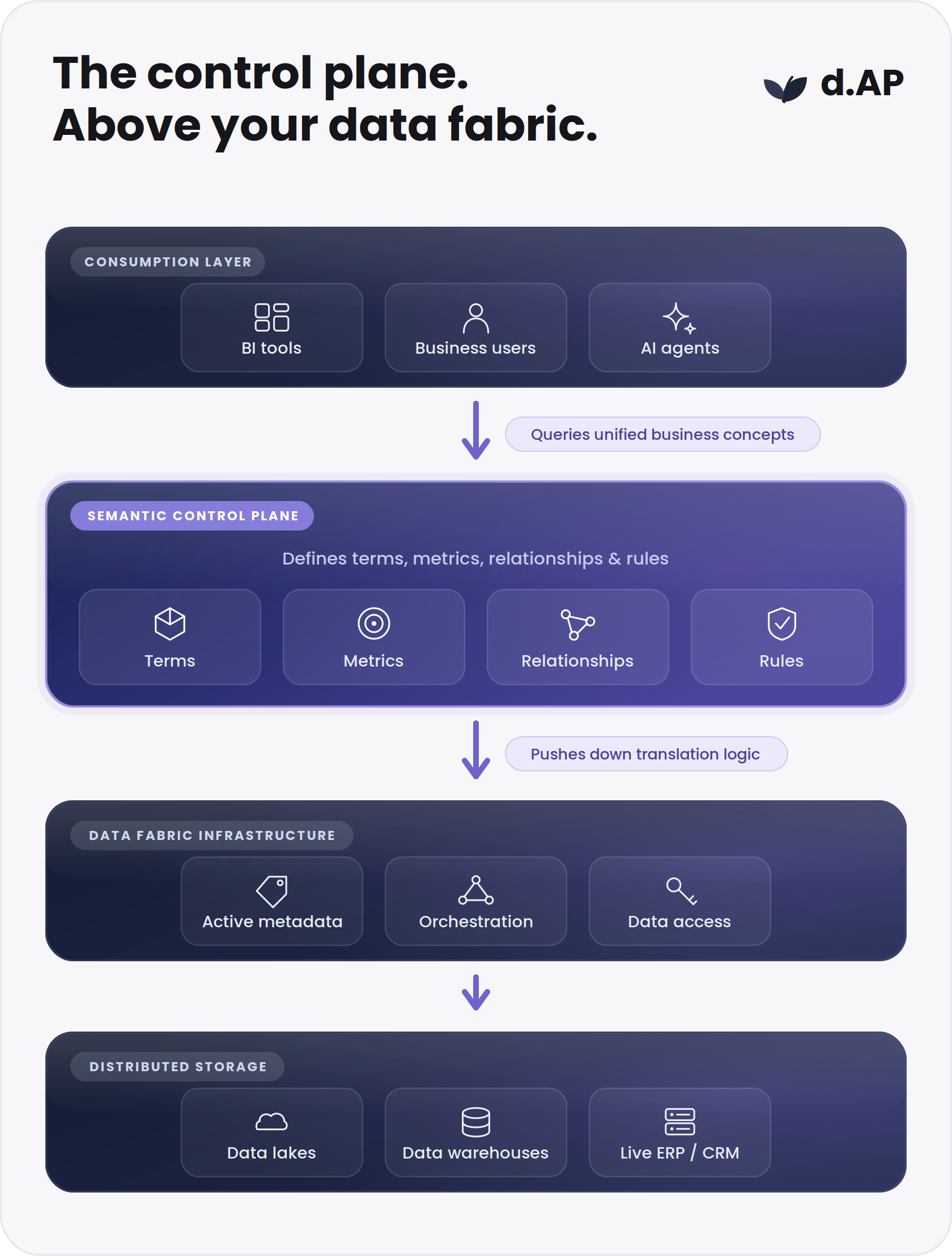
The semantic layer turns access into interpretation
A data fabric gives consumers access to distributed data. A semantic layer tells those consumers what the data means. It defines shared business concepts, metrics, data relationships, rules, access controls, and lineage so every consumer resolves the same business question in the same way.
That means a query about revenue, defect rate, customer risk, or supplier exposure doesn't depend on which source system, data warehouse, data lake, or reporting tool a user happens to touch. This is where business context becomes part of the BI layer, rather than something analysts have to reconstruct manually from the physical storage systems.
Data fabric, data mesh, and semantic layer each solve different problems
It's vital to distinguish these neighbouring concepts so your data strategy doesn't collapse into vague architectural terms:
- Data Fabric: Focuses on integrated data access and automated delivery across distributed systems.
- Data Mesh: A decentralised, domain-owned approach to creating and managing data products close to the work. You can explore how semantics scale this model in Scaling Data Mesh with Semantic Layers.
- Semantic Layer: The shared model of meaning that keeps either architecture coherent for data consumers.
A semantic layer doesn't compete with the fabric. It makes the fabric useful at the point of data consumption.
The BI outcomes a semantic layer drives across the enterprise
A semantic layer matters because it changes what the fabric produces for leadership: not just more access, but more consistent, trusted, explainable, and reusable business intelligence.
One version of the truth across every BI tool
A semantic layer defines key metrics and entities once, then reuses those definitions across business intelligence tools, dashboards, reports, and ad-hoc analysis. Revenue, customer, churn, defect, product quality, and margin shouldn't be redefined differently inside Power BI, Tableau, spreadsheets, notebooks, and data pipelines.
The semantic layer gives data consumers one governed interpretation of each metric. Local variations can still exist, but they become explicit and named rather than accidental. As a result, dashboards are easier to reconcile, teams spend less time arguing over whose number is correct, and the semantic layer’s role in business intelligence becomes easier to trust.
Faster time-to-insight and more reliable self-service
A data fabric can help users find and access data, but without a semantic layer, users still need help interpreting the underlying schema, joining the right sources, and choosing the correct definitions. A semantic layer lets business users query meaning rather than schemas.
Instead of asking data engineers to locate tables, join sources, and explain fields, users can ask questions in familiar business terms. Data analysts and data scientists can also work from a shared logical data model rather than rebuilding context for every request. This means fewer BI tickets, fewer clarification loops, faster data exploration, and less manual data preparation before the business can act.
Governance, lineage, and trust at enterprise scale
Governance becomes harder as a fabric connects more sources. A semantic layer helps by moving data governance closer to business meaning. Instead of enforcing rules only at the level of tables, columns, and storage systems, the enterprise can apply policies directly to business concepts, such as:
- Customer contract value
- Employee salary
- Regulated asset exposure
- Supplier risk
- Product quality issue
Access controls, lineage tracking, and data governance can then travel with the concept across every source the fabric touches. That control becomes especially important when the same fabric starts serving AI systems, not just dashboards.
AI- and agent-readiness
AI agents and machine learning models struggle to reason safely over raw data, disconnected tables, or fragmented documents if they don't understand the business meaning behind them. A semantic layer gives AI systems a structured, queryable model of the business: concepts, relationships, rules, and constraints. That makes the fabric more useful for GenAI, predictive analytics, and agentic workflows.
This is where semantic layers and GenAI start to reinforce one another: the same shared meaning that helps BI users also gives AI systems a safer foundation to query. Grounding models in machine-readable meaning also reduces hallucination risk by giving AI systems clearer business context at query time.
Reuse, lower cost, and less technical debt
Without a semantic layer, each new reporting, analytics, or AI use case can require fresh data preparation, fresh joins, fresh definitions, and fresh governance logic. With a semantic layer, definitions and query logic become reusable data assets.
A metric defined for financial steering can be reused in operational planning. A customer-risk concept created for supply chain analysis can support future service, sales, or compliance workflows. Federated access and semantic reuse reduce the pressure to treat replication or zero-copy access as the whole answer. The more durable value comes from reusable meaning, not just another way to reach the data, balancing the trade-offs we outline in our analyses of why semantics, not zero-ETL, wins the architecture battle, and why unnecessary replication triggers the zero-copy illusion across multi-platform strategies.
What separates a fabric that delivers from one that does not
A fabric that delivers BI value is not just better connected. It has the right kind of semantics layered onto it.
Analytic semantics make dashboards agree
Analytic semantics are the metrics, dimensions, hierarchies, filters, and row-level permissions that help BI tools report consistently. They are important. A fabric without analytic semantics still leaves dashboards and reporting tools to define metrics locally.
But analytic semantics are not enough for every enterprise workload. They help with measures and reports, but they don't fully represent entities, complex relationships, operational context, or machine-readable business logic.
Knowledge semantics make the fabric machine-readable
Knowledge semantics go further. They represent the enterprise as a connected model of entities, relationships, rules, constraints, and context. This is where ontologies and knowledge graphs matter.
An ontology defines the core concepts and relationships in a business domain, so systems can interpret those concepts consistently, establishing ontologies as the stable foundation of your graph. A knowledge graph connects those concepts directly to real enterprise data. For a semantic data fabric, that means the semantic layer is not just a metrics catalogue. It's an active intelligence tier that lets BI tools, business users, applications, and AI agents reason over complex relationships. The data fabric is only as intelligent as the semantics layered onto it, which is why knowledge graphs are the foundation of modern data architecture.
Example: what ontology-grounded semantics look like in practice
In d.AP, this ontology-grounded pattern is implemented as a knowledge layer above existing enterprise systems rather than replacing them. It doesn't replace data platforms such as Databricks or Snowflake, or operational systems such as SAP and Salesforce.
Instead, d.AP uses open standards such as RDF and OWL2 to model business meaning, maps distributed sources in place through RML, and exposes one queryable surface for BI tools, business users, and AI agents through interfaces such as SPARQL, REST, MCP, and A2A. The architectural point is that knowledge semantics make the fabric explainable down to source, rather than simply naming metrics for reports.
Putting it together: what this looks like in the enterprise
To see how this works in practice, consider how an ontology-backed semantic layer transforms data retrieval across three common business intelligence scenarios.
Supply chain risk
- Situation: A manufacturer needs to know which customer orders are exposed to a supplier disruption. The answer spans ERP, supplier systems, logistics data, contract records, and operational data.
- Fabric-Only Result: The data fabric can expose the relevant data sources. But supplier, part, customer, order, and risk may still be defined differently across systems, requiring data analysts to spend days manually checking references.
- Fabric + Semantic Layer Result: The semantic layer resolves those concepts consistently using an integrated model. Business users can ask a cross-system question and get an answer that traces back to source systems, unlocking the exact precision detailed in our overview of supply chain risk management.
Product quality analytics
- Situation: A product quality team wants to connect field defects, warranty claims, production batches, component suppliers, and product lines.
- Fabric-Only Result: The fabric can provide data access across production systems, warranty databases, and data warehouses. But the term "defect" may mean different things in engineering, manufacturing, and customer service, causing query performance to plateau.
- Fabric + Semantic Layer Result: The semantic layer defines defect, product, batch, root cause, and supplier relationships so data analysts and operations managers can query across complex relationships with confidence, delivering the outcomes explored in product quality analytics and production & operations management.
Financial steering
- Situation: Leadership wants one view of revenue across Sales, Finance, and Controlling.
- Fabric-Only Result: The fabric gives access to all relevant revenue data, but each system still carries its own definition, turning the monthly report into an extended reconciliation debate.
- Fabric + Semantic Layer Result: The semantic layer makes each revenue definition explicit and governs when each version should be used. Leadership can see the answer, the calculation logic, and the source lineage natively, driving the exact alignment outlined in controlling & financial steering.
Is your fabric semantically ready? A short diagnostic
You can evaluate your current architecture by taking these diagnostic questions into your next data strategy conversation:
- Do your core business concepts (customer, product, revenue, defect, asset, supplier) have shared definitions across systems, or one definition per platform?
- Can business users answer a cross-system question without asking data engineering to interpret the underlying schemas?
- Does your semantic model describe only BI metrics, or does it also represent relationships, rules, and constraints that an AI agent could read?
- When a number appears in Power BI or another BI tool, can your team trace exactly how it was calculated and which source systems supported it?
- Can your access controls be applied directly to business concepts, or only to physical tables and columns?
- Will your semantic definitions survive a vendor change, or are they locked inside one reporting tool or data platform?
- Can AI agents query the fabric with enough business context to produce explainable answers?
If too many answers are "one per system," "only in the BI tool," or "we need engineering to check," the issue is not only data access. The fabric may be moving data before the enterprise has agreed what that data means.
Conclusion: the fabric’s ROI depends on meaning
A data fabric without a strong semantic layer scales access, but it can also scale inconsistency. It gives more people, tools, and systems access to more data sources, but it doesn't automatically create shared understanding.
A fabric with a semantic layer does something more valuable. It turns distributed enterprise data into consistent metrics, trusted self-service, explainable governance, reusable logic, and AI-ready business context.
The semantic layer is not a downstream BI convenience. It's the architecture decision that determines whether your data fabric becomes a trustworthy decision system or simply a faster way to move conflicting numbers. If you're already building a fabric, the next question is not whether data can move across your systems. It's whether your business meaning can move with it.
To explore how an ontology-grounded knowledge layer can operationalise this pattern, start with the use case where conflicting definitions are already slowing decisions.